


Recently, LifeWay’s research arm published a striking article:
2 in 3 Churchgoers Fail Bible Literacy Quiz
After reading through the content and results, which I’ll lay out in a moment, I couldn’t help but take the quiz myself to test my knowledge. To my surprise, I aced it.
Now, this isn’t me patting myself on the back. I got hung up on some of the questions, like which event happened first. Most of the questions were thoughtfully designed to have a definitive answer, yet still had options that, at a quick glance, could feel right if you didn’t pay attention.
As I think back on how I learned the Bible’s storyline and what “literacy” would entail in this research, I didn’t arrive at that understanding by pure luck or sheer individual effort. Early on, my small group leaders and pastoral mentors instilled in me the practice of learning the context of passages. As one of my professors once said, what we were doing was looking at real people doing real things in real places at real times.
The books, chapters, and verses were not words on a page but events where God acted in history. And I don’t want to be naïve and think this happens everywhere. If those who took the quiz attend church services regularly and can’t pass it, then whatever our churches are teaching isn’t sticking.
But does it really matter if someone can pass a Bible quiz? If someone claims to be a Christian, who cares if they don’t know where something happened in the Old Testament?
The findings are staggering.
Of the 2,012 American churchgoers—mixed across Protestant, Catholic, and Orthodox traditions—who identify as regular attenders, the average score was 51%. 65% flat-out failed.
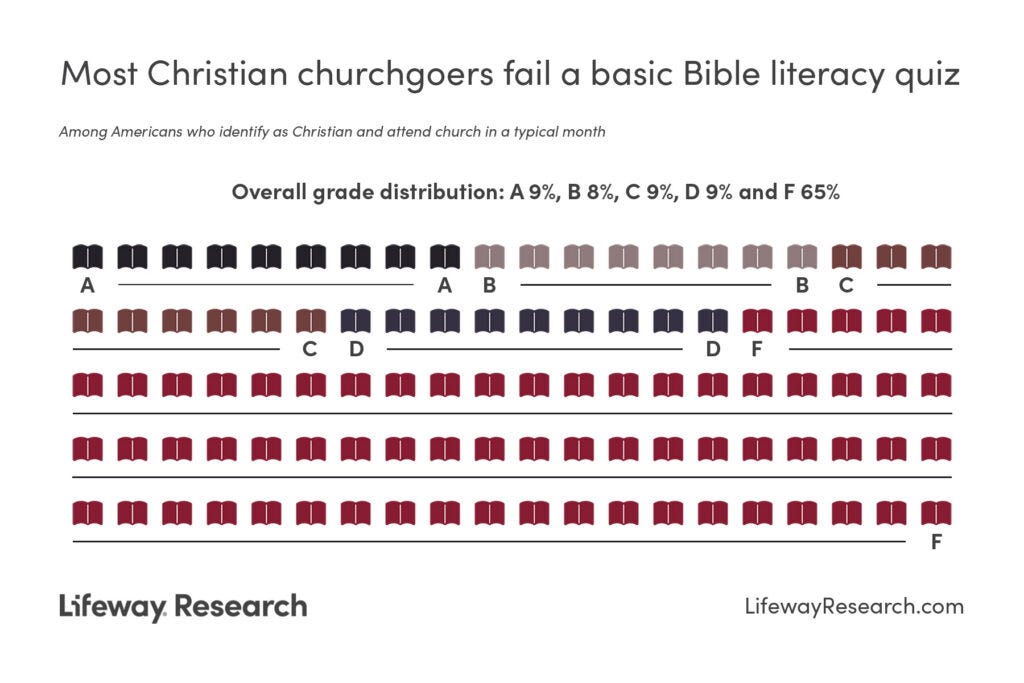
They knew the familiar pieces. 94% matched Moses to the Ten Commandments, and 80% could finish John 3:16. When asked to put events in order, though, the numbers fell apart. 11% got Deborah, Goliath, Jonah, and Esther in the right order. 27% got Mary’s song, Nicodemus, Peter’s denial, and Paul’s arrest in the right order.
(Admittedly, I can see where some of the confusion comes from. Book order—like Esther coming before Jonah canonically—could easily catch someone off guard when you’re so used to reciting them from memory in a specific way.)
28% could fill in the missing word in Micah 6:8: “walk humbly with your God.”
Some put things in the Bible that aren’t even there. 44% believed the Gospel of Thomas belonged in the Canon. 51% placed Haggar, a book that doesn’t even exist, in there. 49% missed that “God helps those who help themselves” isn’t a verse at all.
When asked why they read the Bible, 62% said to know and relate to God. 56% named a pastor’s sermon as one way they learn Scripture in a typical week. 37% read passages straight through.
So it’s clear that people want to know God, but they hold the Bible as pieces instead of a story. If the primary way we know God is through His Word, then the question isn’t how much knowledge you retained, but whether you can know Someone whose story you can’t tell.
The good news is, God makes himself known by acting in and through history. Take a look at Luke 1:1-4:
1 Many have undertaken to compile a narrative about the events that have been fulfilled among us, 2 just as the original eyewitnesses and servants of the word handed them down to us. 3 So it also seemed good to me, since I have carefully investigated everything from the very first, to write to you in an orderly sequence, most honorable Theophilus, 4 so that you may know the certainty of the things about which you have been instructed. (Luke 1:1–4 [CSB], emphasis added)
Luke’s stated goal is that real things happened in front of real people, and he lays them out in order so we can be certain what we learned about Jesus is true.
It gets more interesting in Luke 24. On the third day after the crucifixion, two of Jesus’ followers (not one of the main Twelve) are leaving Jerusalem. The risen Jesus joins them, and they don’t recognize him. They’re walking beside the one they had counted on to be the Messiah, and they’ve given up hope. When he asks what they’re talking about, they stop, and Cleopas answers:
18 The one named Cleopas answered him, “Are you the only visitor in Jerusalem who doesn’t know the things that happened there in these days?”
Then Cleopas tells the “stranger” about Jesus of Nazareth, a prophet powerful in what he did and said. He names the chief priests and the rulers who handed him over. He knows about the cross, the third day, the women at the tomb, the angels, and the missing body.
Everything he said was factual. Cleopas would’ve gotten a perfect score on that LifeWay quiz.
And he relays it all to Jesus. Joel Green points out the irony: Jesus is the one person on that road who is “genuinely ‘in the know.’”1
So, what was missing? Jesus lets them know.
25 He said to them, “How foolish you are, and how slow to believe all that the prophets have spoken! 26 Wasn’t it necessary for the Messiah to suffer these things and enter into his glory?”
Cleopas had the events, but he just couldn’t see how they all fit together. Suffering, then glory. That’s the whole plot, and without it, his facts added up to “we were hoping” (v. 21).
Thabiti Anyabwile says it best: “These men know the facts of the gospel, but they don’t yet recognize the face of the gospel.”2
Jesus responds to their confusion with a biblical flyover.
27 Then beginning with Moses and all the Prophets, he interpreted for them the things concerning himself in all the Scriptures.
Tom Schreiner says Jesus “explains how the entire storyline of Scripture points to himself.”3 He gives them the whole story, beginning to end.
Facts are still important here. Jesus calls them “slow to believe all that the prophets have spoken.” All. They believed some of it, but just some isn’t enough.
Luke tells us something else, though. On the road, “they were prevented from recognizing him” (v. 16). At the table, “their eyes were opened, and they recognized him” (v. 31). Later that night, Jesus “opened their minds to understand the Scriptures” (v. 45). Someone else is doing the opening.
At this point, you might be thinking, “If God has to open my eyes anyway, why even bother learning the story?” Fair, but look at what they say once he left.
32 They said to each other, “Weren’t our hearts burning within us while he was talking with us on the road and explaining the Scriptures to us?”
Their hearts burned on the road before they even recognized who he was. The opened Scriptures were how he came near.
You can’t know him apart from his story, and you won’t see him by the story alone.
Nehemiah 8 shows the same thing, but on a larger scale. With the wall finished, the people gather in the square and ask Ezra to bring out the book of the law (8:1). He reads it from morning till noon—about 6 hours of listening.
Reading here means more than just reciting words; it’s reading plus explaining. The Levites “explained the law to the people as they stood in their places” (v. 7). They read from the book, “translating and giving the meaning so that people could understand what was read” (v. 8).
When Ezra read, the people wept. Then they were told to eat, drink, send portions to anyone with nothing prepared, and celebrate. They did, “because they had understood the words that were explained to them” (v. 12). Jim Hamilton sums it up: “They rejoice because they have understood Scripture.”4
Brian Aucker adds the line that ties Nehemiah to Emmaus. The people’s response, he writes, is “inexplicable apart from the work of the Spirit of God.”5 People read. People explained. But God gave the understanding.
This is the work of Redemptive Correlation: reading a cultural moment, like LifeWay’s numbers, through Scripture’s four-act story of creation, fall, redemption, and restoration.
Creation. From the very beginning, God speaks to the people he makes. He blesses them and gives them work (Gen. 1:28). He gives Adam a word to live by in the garden (Gen. 2:16-17). We were made to be addressed by God.
Fall. The first temptation opens with a question and challenge about that word: “Did God really say…?” (Gen. 3:1). We’ve struggled ever since to hold on to what God said. The Emmaus disciples held the facts while missing their meaning, and Jesus calls it a slow heart.
Redemption. The risen Christ opens the Scriptures and opens minds (Luke 24:27, 45). He gives both the story and the eyes to see it.
Restoration. God promises a day when “they will all know me, from the least to the greatest of them” (Jer. 31:34). That’s where the gap in the data closes: in knowing God himself.
So let me ask the real question—the one that lies beneath all the percentages and data. Could you tell God’s story? Start with Adam and Eve, continue with Abraham, Isaac, Jacob, David, and Solomon, and keep going to the empty tomb. How far do you think you’d get before things stop connecting?
If you’d get stuck, don’t be embarrassed. Two of the people who followed Jesus did, and he met them on the road out of town.
LifeWay’s analysis found one habit that stood out above the rest: reading the Bible daily increased a churchgoer’s score by 14%, the biggest boost of anything they measured. While it’s not a certainty, you can probably see the correlation here: you can’t know a story you don’t read.
So pick a book of the Bible and read it straight through. Not like you probably have—reading a chapter a day—but read it all in one sitting. Reading one of the gospels is a great place to start, like Luke.
Read it the way the Emmaus disciples learned how to. Ask God to open your eyes. Schreiner puts it simply: “We ask the Lord to open our minds as we read.”6 When Jesus acted as if he were going farther, they urged him to stay (v. 29). When he stayed, they recognized him at the table.
If you’ve stepped away from church because no one helped connect the pieces, this road is for you too. Jesus came alongside two people leaving Jerusalem, who had left their hope at the city gate as they walked through it. And the first thing he did was ask what they were talking about.
If someone who walked away asked you to tell them God’s story, could you?
The main reason why I passed that quiz is that people sat with me when I was younger and put Scripture in its proper place and time. My leaders and pastors did the work just like the Levites did. They read it and explained its meaning.
Nehemiah 8 doesn’t stop with the big reading out in the open. The next day, the family leaders, Levites, and priests came back to Ezra “to study the law” (8:13), and then they passed it along to the rest of the towns and Jerusalem. Study, then hand it on.
The church needs more people like this. If you lead in some capacity—whether in a small group, Sunday school class, or just being there for someone else—you’re doing the work of the Levites. So do it like it matters, because it really truly does.
We also can’t do the Christian life alone. LifeWay found that people who attend church weekly averaged 55% compared with 44% who attend monthly. God’s story sticks with us when we hear it together.
The Emmaus disciples knew that, because the same hour their eyes were opened, they walked back to Jerusalem. They found the others gathered, and then told them what happened on that road and at that table (24:33-35).
One day, literacy quizzes won’t matter. “They will all know me.” Until that time, we meet, open the book, and ask him to stay.
Joel B. Green, The Gospel of Luke, NICNT (Grand Rapids: Eerdmans, 1997), 845.
Thabiti Anyabwile, Exalting Jesus in Luke, CCEC (Nashville: Holman Reference, 2018), 356.
Thomas R. Schreiner, “Luke,” in Matthew-Luke, ed. Iain M. Duguid, James M. Hamilton Jr., and Jay Sklar, ESVEC 8 (Wheaton, IL: Crossway, 2021), 1098.
James M. Hamilton Jr., Exalting Jesus in Ezra-Nehemiah, CCEC (Nashville: Holman Reference, 2014), 159.
W. Brian Aucker, “Nehemiah,” in Ezra-Job, ed. Iain M. Duguid, James M. Hamilton Jr., and Jay Sklar, ESVEC 4 (Wheaton, IL: Crossway, 2020), 188.
Schreiner, “Luke,” 1099.